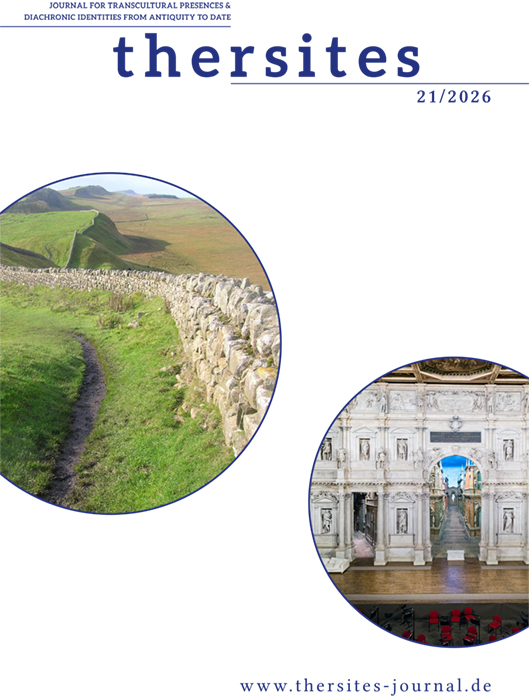
Hadrian’s Wall, 1850–1950: Frontier and Monument
DOI:
https://doi.org/10.34679/thersites.vol21.304Keywords:
Hadrian’s Wall, Roman Empire, frontiers, British Empire, Roman BritainAbstract
This paper discusses the place of Hadrian’s Wall in British intellectual life between the mid-nineteenth and mid-twentieth centuries, and charts its development through three key phases: the new season of archaeological and antiquarian research spearheaded by John Collingwood Bruce; the ground-breaking methodological reflections of Francis Haverfield and R. G. Collingwood; and the debates on the Wall as an ancient and modern frontier, from Rudyard Kipling to Winston Churchill and W. H. Auden. The Appendix reproduces an important 1921 paper by R. G. Collingwood that is virtually inaccessible outside the United Kingdom.
Downloads
Published
Issue
Section
License
Copyright (c) 2026 Federico Santangelo

This work is licensed under a Creative Commons Attribution 4.0 International License.
Authors who publish with thersites agree to the following terms:
- Publishing in thersites is free of any charges.
- Authors retain copyright and grant the journal right of first publication.
- Users are allowed to read, download, copy, distribute, print, search, or link to the full texts of the articles, or use them for any other lawful purpose, without asking prior permission from the publisher or the author, so long as the original work is properly cited and is not used for commercial purposes. The journal is published under the Creative Commons Attribution 4.0 International License. More information about this license is available at https://creativecommons.org/licenses/by/4.0/.
- Authors are able to enter into separate, additional contractual arrangements for the non-exclusive distribution of the journal's published version of the work (e.g., post it to an institutional repository or publish it in a book), with an acknowledgement of its initial publication in this journal.
- Authors are permitted and encouraged to post their work online (e.g., in institutional repositories or on their website) as it can lead to productive exchanges, as well as earlier and greater citation of published work (See The Effect of Open Access).